The thing about Switzerland’s affordable, hyper-reliable, hyper-integrated and hyper-ubiquitous public transport system is that the regard in which its phenomenal operational expertise is held can overshadow the architectural successes it also demonstrates. Even when transport architecture does enter consideration, thanks to Switzerland’s reputation for scenic delights it can be hard to shift the mental picture of Swiss public transport architecture that looks like this:

Yet Switzerland is also a go-to destination for modern transport architecture, as this website has averred in the past (for instance at Chur and Basel). Examples can be found not just at large interchange points in the centre of urban areas, but at suburban locations too. It is quite possible to come across examples completely unexpectedly, which is the experience of many arriving at Adliswill station in the south-western suburbs of Zurich.
The station itself (part of Zurich’s SZU city rail operation rather than SBB’s national railway system) is nothing remarkable, simply taking up part of the ground floor of a low rise residential building. Outside it though, a recently remodelled transport hub has gifted Adliswil some smart and unusual buildings for several transport modes, complemented by an intriguing visual language for the transport hub’s wayfinding information.
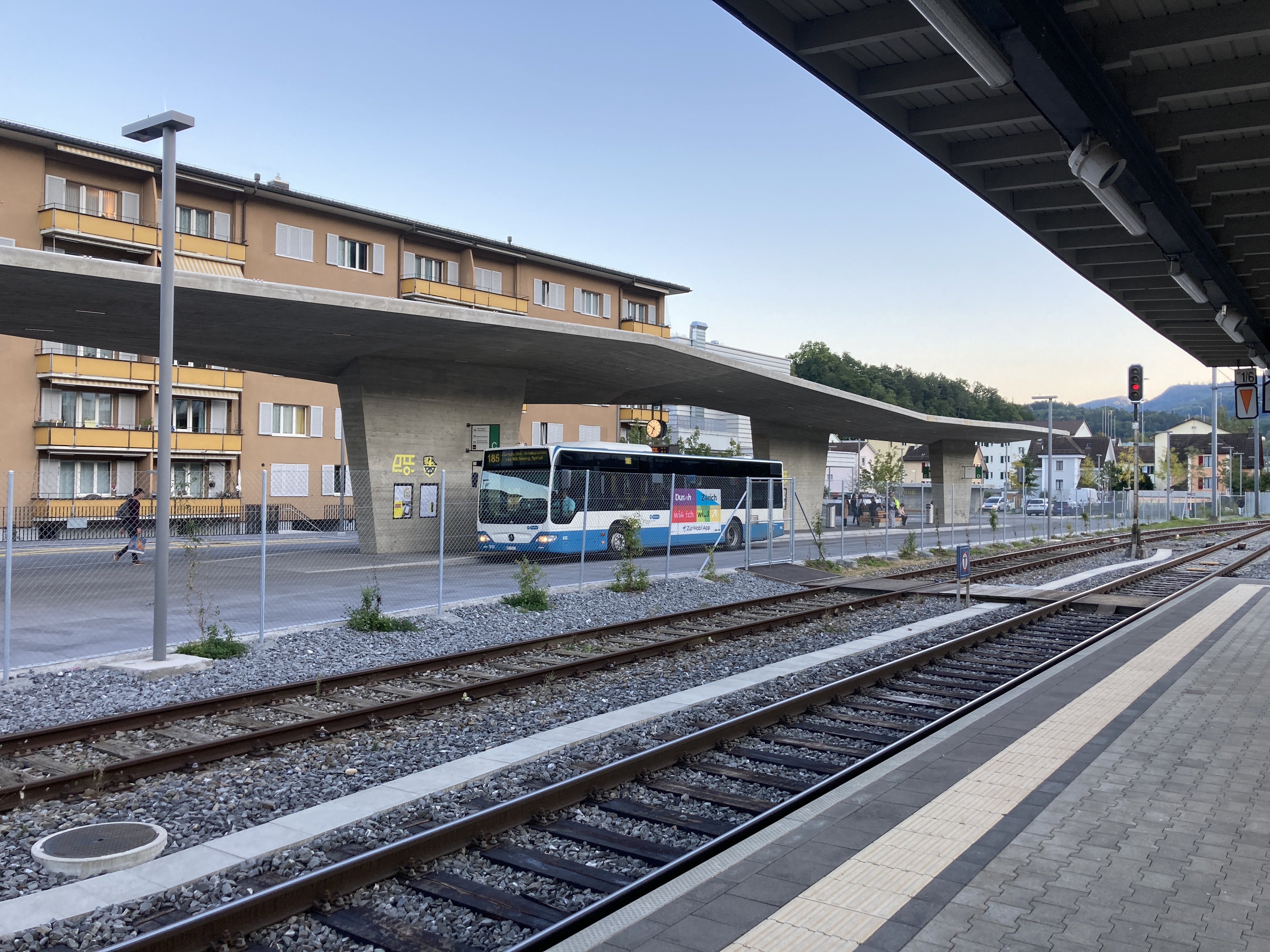
Here is the bus station, seen from the platform of the railway station. The close proximity and visual impact of the bus station means that passengers interchanging from rail to bus already know what they are looking for and where they are going, once they have exited the railway station.
Although impressive when seen from the railway station, the bus station is even better seen from outside the railway station, on Florastrasse itself.
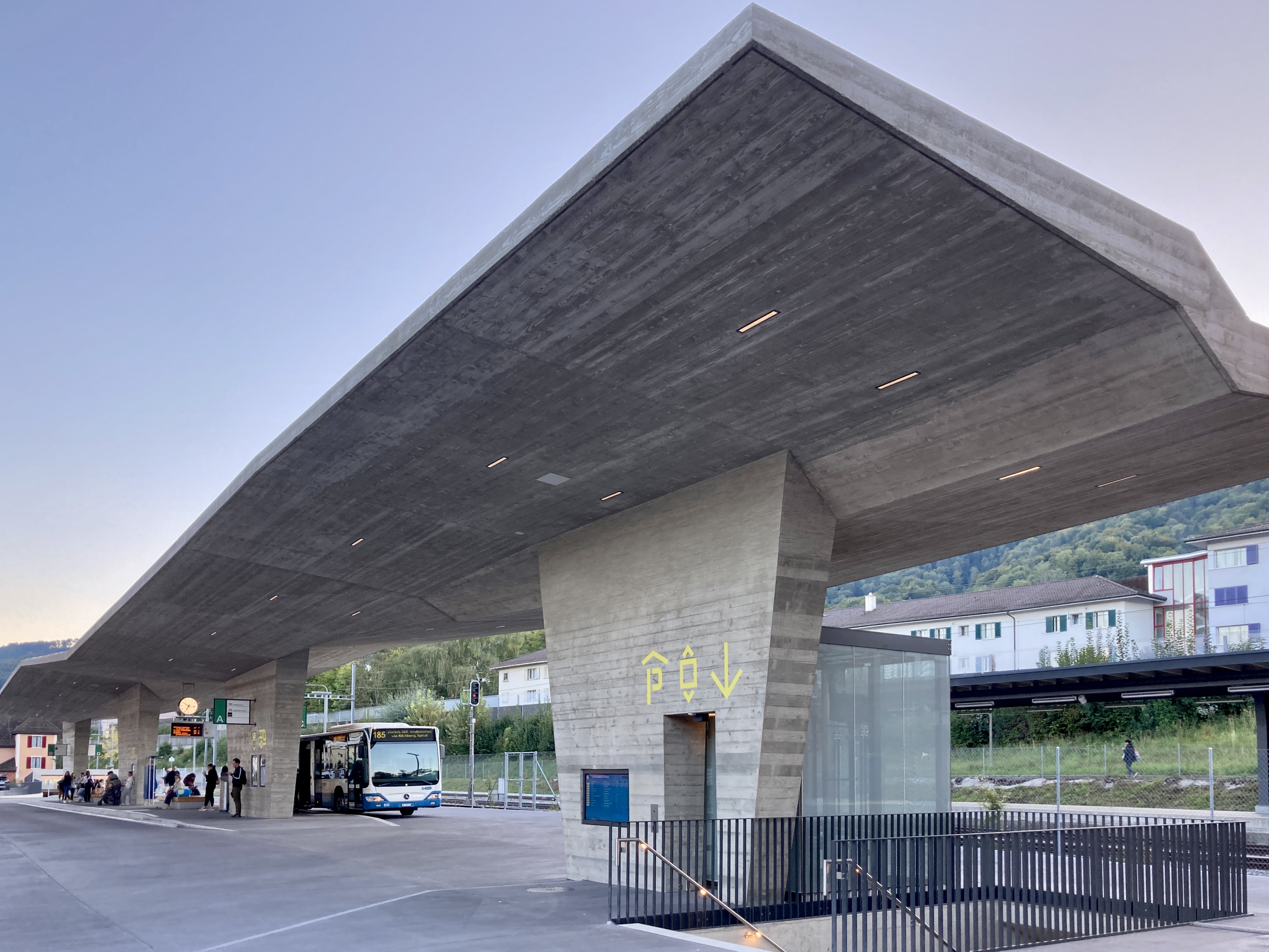
In the foreground of the picture above is the entrance to an underpass and underground parking garage, with the bus stands in the background. A cranked concrete roof undulates along its length, sheltering both the entrance to the underpass and parking garage (stairs and a lift) and the bus stands, of which there are four.
Regular readers will know of this website’s ambivalence towards some of the Brutalist movement, especially when its buildings tends towards the bulky. But there is nothing fundamentally wrong with the use of raw concrete, or Béton brut (from which Brutalism gets its name), when used as lightly and as cleverly as it has been by St Gallen-based architects amplatz Architekten & Planer.
This bus station is a beautiful piece of engineering and architecture, which sits very comfortably in its local environment. The imprint of the wooden formwork used to cast the bus station’s concrete provides a visual link between the wooded hills which are the backdrop to Adliswil, and the more immediate built environment. The shape of the roof is intended as an evocation of the topography of the nearby Zimmerberg, and the hydroelectricty generated by the River Sihl which flows through Adliswil and parallels the railway for much of its length.
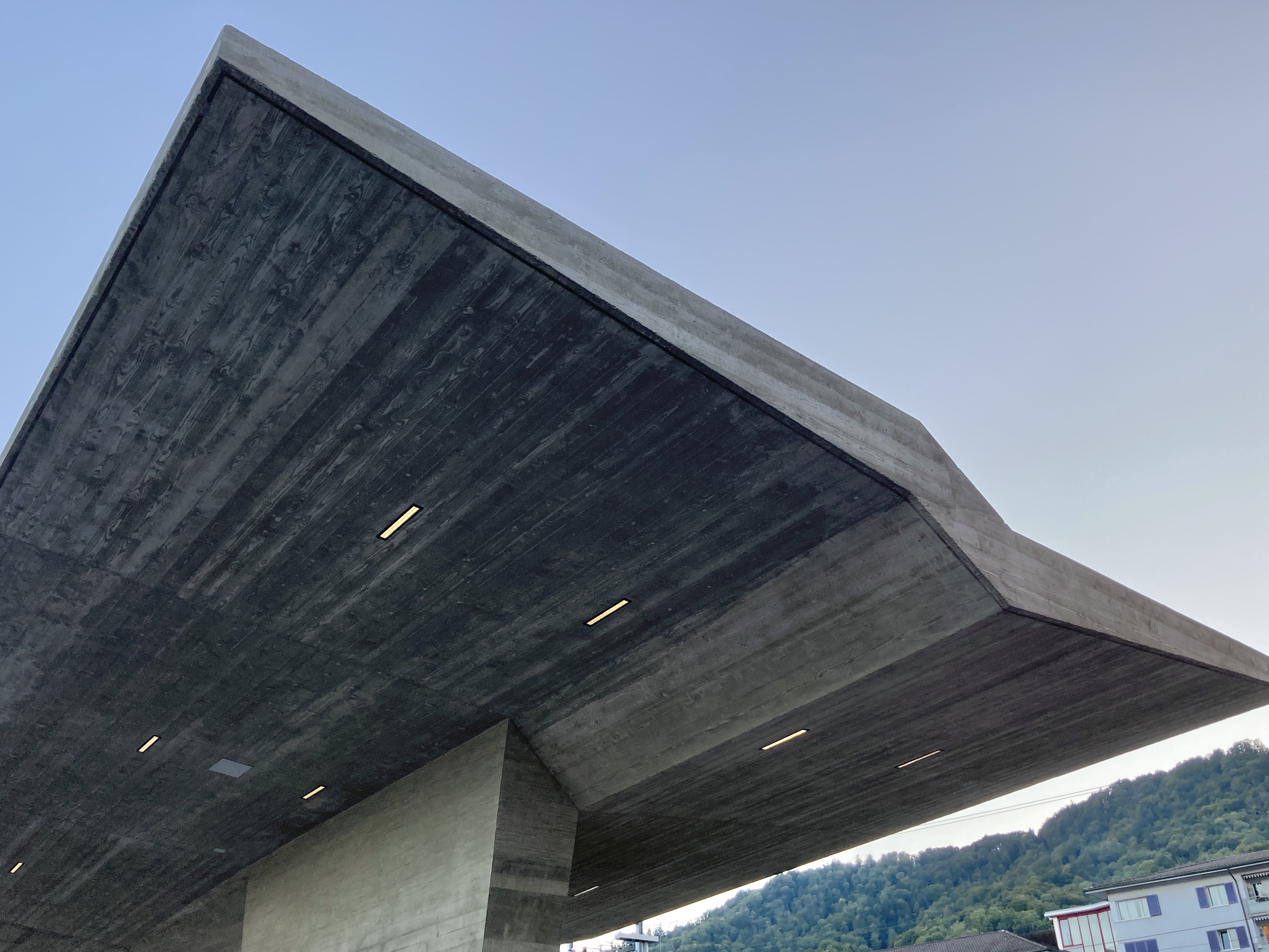
As can be seen in the picture above, the bus station has extremely clean lines with lighting installed flush on the underside of the canopy; no untidy wires, trunking or conduit here, just a neat shadow gap around the edge. The only thing hanging from the roof is a clock; this is Switzerland after all. Timber seating on concrete plinths is provided for waiting passengers.
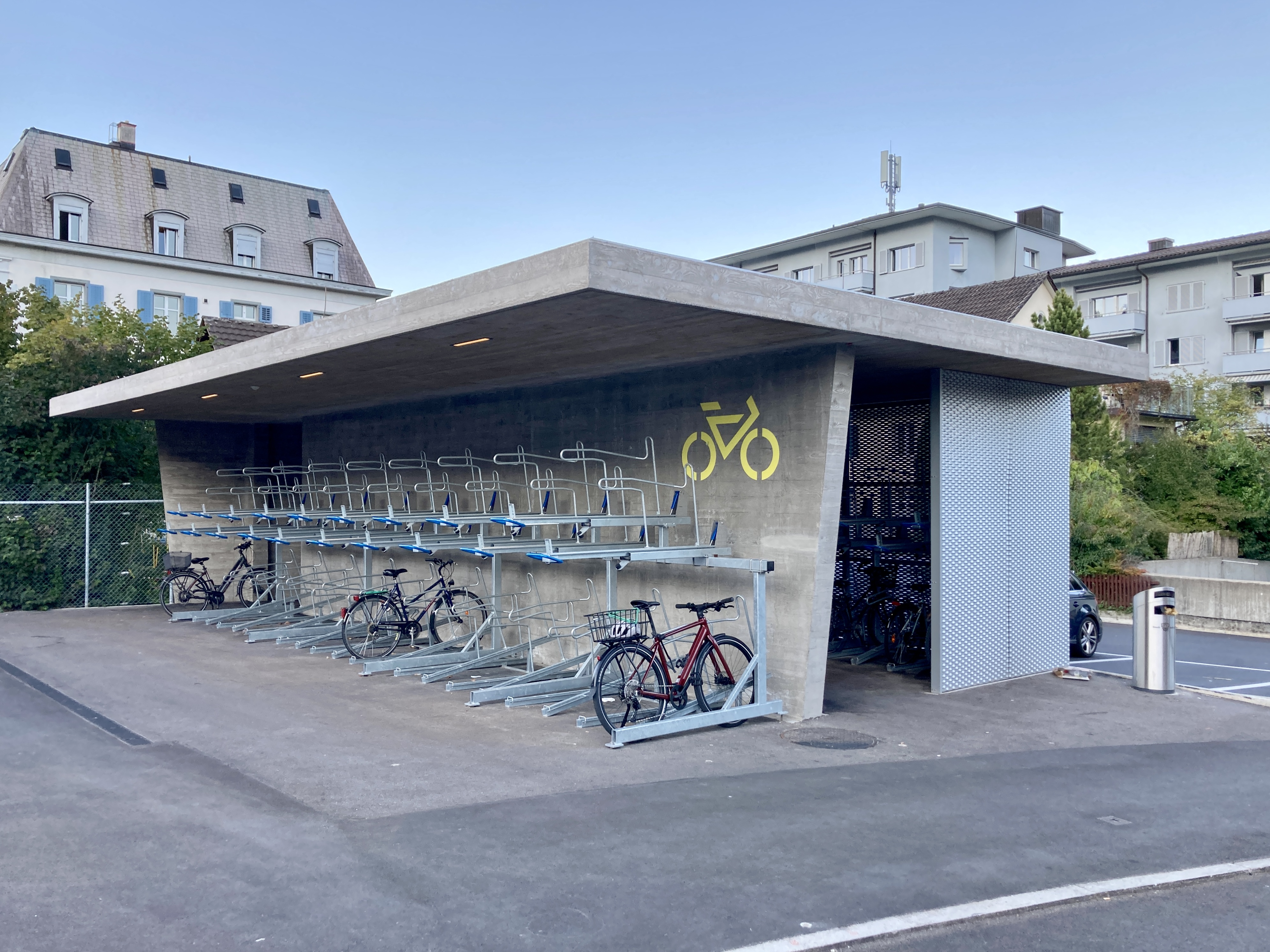
Just across from the bus station on the other side of Florastrasse is a cycle park in complementary style and materials. A double deck outdoor rack is situated under the oversailing roof (again with flush mounted lighting), while there is additional double deck parking with better weather protection inside the shelter – mesh walls assist with maintaining visibility from inside to out.
The yellow stencil-style icons are an unusual wayfinding scheme that (a) do the job, and (b) complement the modern styling of the transport hub’s building. Here are some, grouped together.
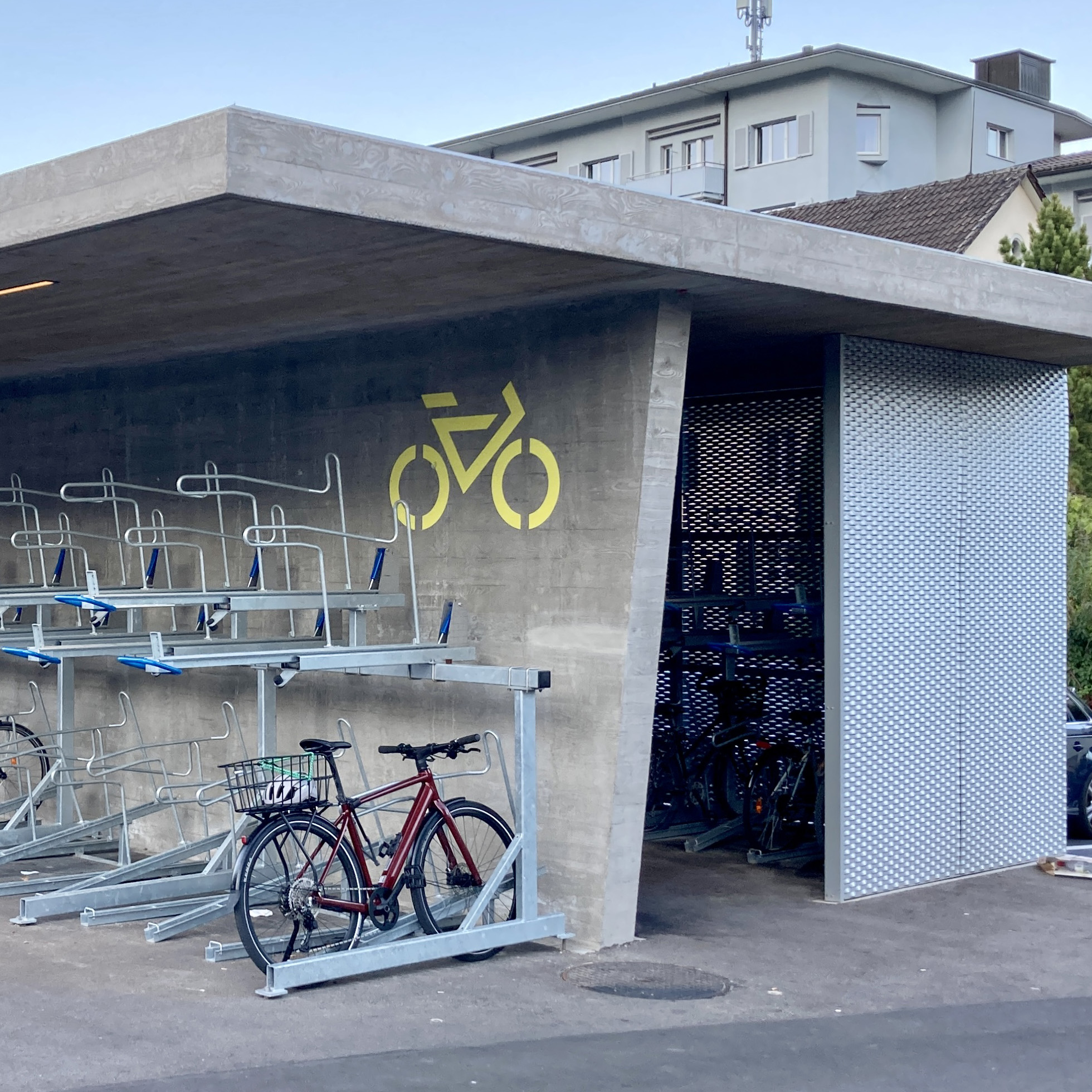
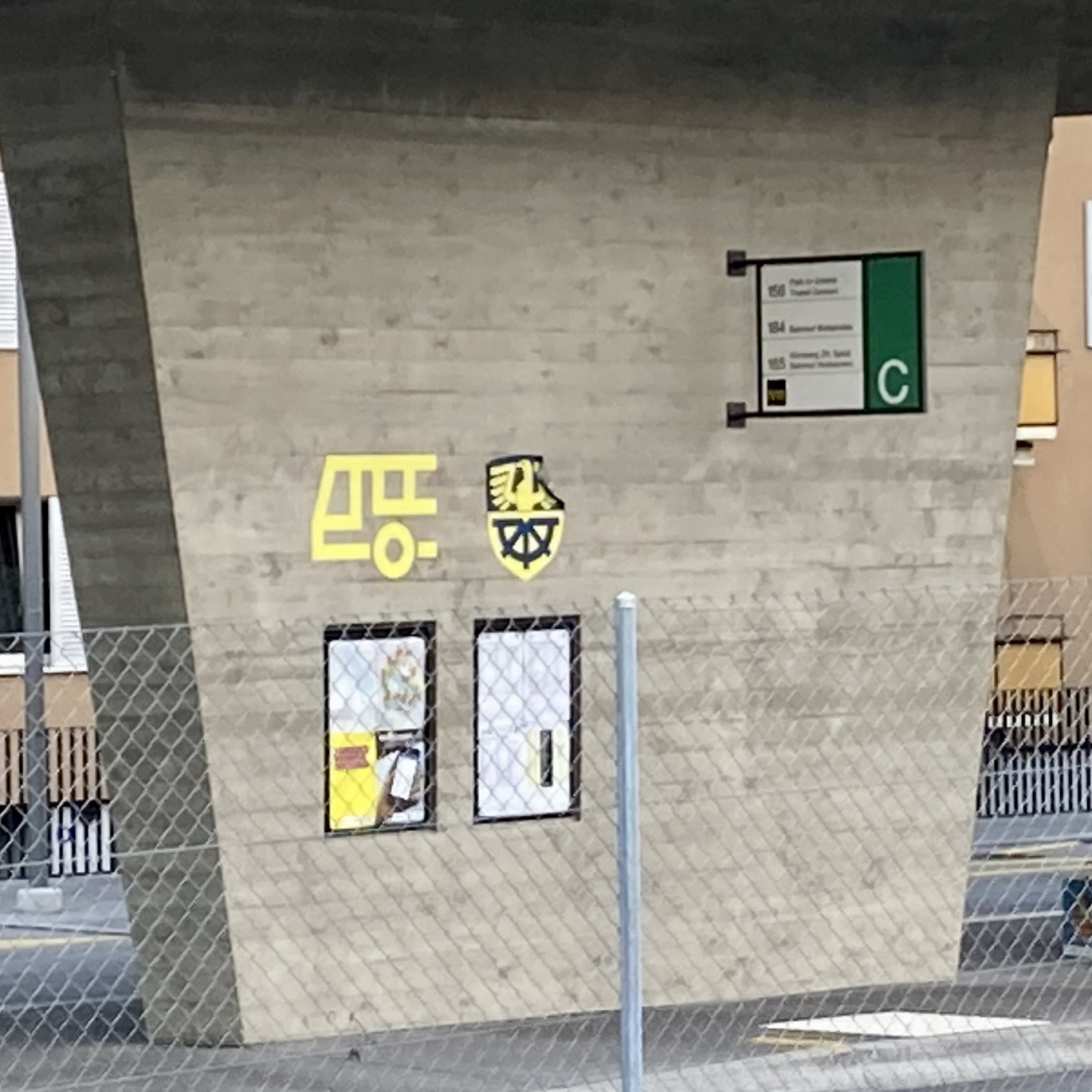
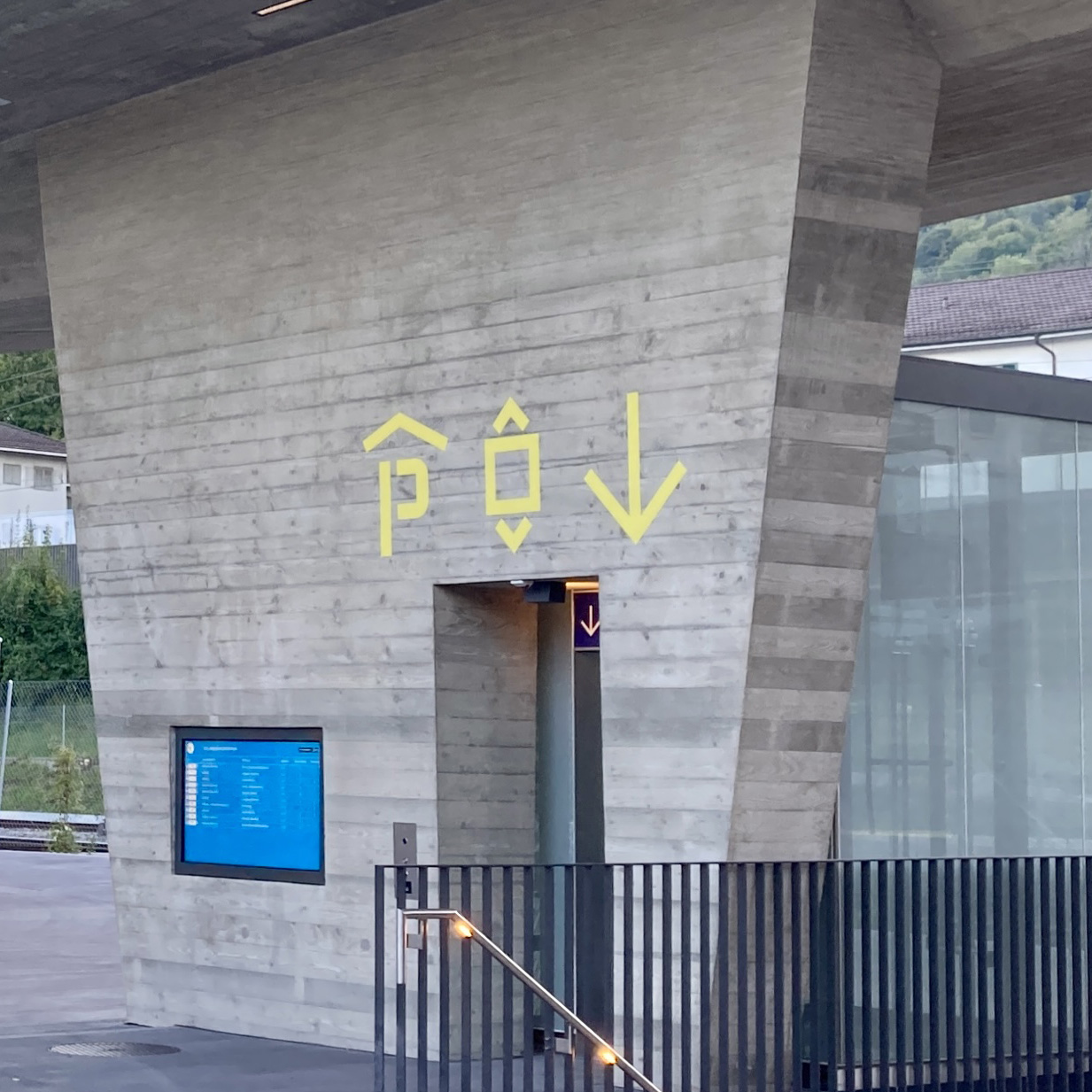
↑ Wayfinding details, Adliswil transport hub. Photo by Daniel Wright [CC BY-NC-ND 4.0]
Underground, the underpass has similar stencil-inspired wayfinding but in blue.
The concrete bus station and cycle park, as well as a payment building for car parking, were all built as part of a large scale reorganisation of transport facilities at Adliswil to make a new transport hub, completed in 2022.
The bus station replaced surface car parking, relocated to a remodelled surface car park to the south which also includes additional open air cycle parking. The underground car park was pre-existing but extended and refreshed as part of the project. Taken as a whole, the complex now reflects the hierarchy of sustainable transport modes with the most sustainable modes (cycling, buses) accessible closest to the railway station entrance and the least sustainable (cars) furthest away. It is enough to quite gladden the heart of a transport planner. The transport hub as a whole is a transformation from the anonymous surface car park which used to dominate the area outside the station, through which pedestrians previously had to pick their way.
Of its redesigned transport hub, amplatz says, “The focus is on people as pedestrians.” With easy, step-free pedestrian routes through the complex, clear wayfinding and an easily comprehensible layout, it has definitely achieved its aim. Adliswil’s transport hub embodies the quiet efficiency that is the hallmark of Swiss public transport and is a worthy addition to Switzerland’s great public transport architecture.
HOW TO FIND ADLISWIL TRANSPORT HUB
Click here for The Beauty of Transport‘s map
FOLLOW ON TWITTER
To be alerted to new articles, and for more transport architecture, design, branding and cultural references in between, do consider following The Beauty of Transport on Twitter/X: @BeautyOfTranspt. You’ll find me on Twitter/X at @danielhwright for thoughts about wider transport policy and non-transport things too.
BIBLIOGRAPHY AND FURTHER READING
amplatz Architekten & Planer project page for Adliswil transport hub
B3 (planners and engineers) project page for Adliswil transport hub
Factsheet about Adlsiwil transport hub
…and anything linked to in the article above.
 The Beauty of Transport
When I look at the bicycle graphic I can’t help but see someone sitting between the wheels with their legs in the air.
Seems that Adliswil has made the same arrangements with the weather gods as London Bridge station. Rain only ever falls vertically, and no shelter against the wind is needed because it never blows and it never gets cold.
All the stairs are accidents waiting to happen: handrails are only at the extremities (presumably they’ve never had a Bethnal Green disaster).
Obviously electricity is supplied free of charge and is 100% carbon neutral so there’s no need to waste a few francs on photoswitches, it’s easier to let all the flush mounted lights blaze away all day and night.
Even the signage for the lift to the car park is muddled: the lift only goes down so why the circumflexes above the P and Lift symbols?
It’s all style over substance, and to my layman’s eye there’s precious little of the former. Bet the architects haven’t been on a bus any time this century…
You beat me to it!
All these allegedly beautiful places share one thing in common: they’re utterly awful for the actual users. It seems that the more they’re lauded for their amazing architecture, the worse they actually are to use.
What a pity that we apparently can’t have beautiful buildings that are equally lovely to use.
well, I’m pretty sure it’s fine to turn the lights on at 7 pm…
judging by the fact that the roof seems nearly wide enough to cover the bus too, rain would need to fall at 45° or more to hit your feet when standing next to the wide supports, which should give some shelter from wind in at least one direction. Hurricanes are rare in Switzerland, it should be fine.
The chevron above the elevator box both makes it much more recognizable and also, being a pedant here, the elevator does go up and down, it’s not one way 😉 — the roof over the P indicates that it’s a covered parking facility (looking very similar to the matching road sign).
Also, I doubt the stairs will ever see a crowd big enough to make the normal amount of handrails insufficient and given that it looks quite similar in size and design to the stairs in any other swiss railway station, any accident-inducing design flaws would have been spotted elsewhere first.
I think it’s a nice-looking station with form _and_ function
well, I’m pretty sure it’s fine to turn the lights on at 7 pm…
judging by the fact that the roof seems nearly wide enough to cover the bus too, rain would need to fall at 45° or more to hit your feet when standing next to the wide supports, which should give some shelter from wind in at least one direction. Hurricanes are rare in Switzerland, it should be fine.
The chevron above the elevator box both makes it much more recognizable and also, being a pedant here, the elevator does go up and down, it’s not one way 😉 — the roof over the P indicates that it’s a covered parking facility (looking very similar to the matching road sign).
Also, I doubt the stairs will ever see a crowd big enough to make the normal amount of handrails insufficient and given that it looks quite similar in size and design to the stairs in any other swiss railway station, any accident-inducing design flaws would have been spotted elsewhere first.
I think it’s a nice-looking station with form _and_ function
No amount of clean lines makes up for the inherent grimness of all that grey. Bare concrete is inherently anti-human whatever the other merits of your design.
The underside of the main canopy looks like it’s covered in mould…
..