It is hard to overstate the impact Hackney Wick station makes on a visitor, as well as the unexpectedness of it doing so. Reopened in 2018 after a complete rebuild, it is one of the most photogenic small stations on the British rail network. Yet somehow, it seems to have slipped somewhat under the radar1; a true hidden gem that deserves to be far better known than it currently is.

The reason it is so successful is that Hackney Wick station is both transport facility and work of art, without either aspect ever compromising the other.
A slew of recent station openings at Reading Green Park, Marsh Barton, Thanet Parkway and Portway Park & Ride have led to some heated online commentary about their perceived failures as pieces of architecture. (I have yet to visit any of them so for now I shall reserve comment.) Hackney Wick is important for demonstrating there is nothing inevitable about modern railway stations being aesthetically challenged.
Architects Landolt+Brown worked with their regular collaborator artist Wendy Hardie throughout the design of the station, incorporating design elements reflecting local history and features. The partnership has worked brilliantly.
The exterior of Hackney Wick station combines fair-faced concrete and glass with weathering steel for the canopies. There is a no-nonsense, industrial feel about the design, appropriate for an area long dominated by industry. Above a newly created subway which runs beneath the elevated tracks, large windows give a glimpse up to the platforms, and allow passengers on the platforms to look out onto the new station square and pedestrian/cycle route which the station rebuild has facilitated. To the side of those windows, corrugated shapes in the concrete evoke folding factory doors. Extruded lettering, illuminated at night, gives the station name in typical London Overground style.


The subway under the tracks is divided laterally in two. The public section outside the station is open to all (but not motor vehicles) while the section within the station forms an underpass linking the ticket hall to the platforms. The division is marked by a wall of hexagonal glass pillars set into weathering steel bases. The glass casts a beautiful watery light into the underpass, a deliberate reference to the nearby Lee Navigation.

When the sun is low in the sky, the columns also act as prisms, splitting sunlight into its constituent colours, a nod to the chemical dyes used and sometimes even invented locally. The back wall of the underpass is decorated with a frieze representing molecular chemistry, a reminder of the one-time local chemical industry.

The lighting design is absolutely fabulous, with uplighters at the bottom of the frieze, concealed lighting at the top, and overhead lighting set into flush mounted strips overhead. It is one of the best underpasses at a British railway station, which might sound a slightly niche claim to fame, except that station underpasses are so rarely done well.

Leading up to the platforms are lifts and staircases. While the lifts are a welcome upgrade compared to the long unsheltered ramps which served the station before its rebuild, it is the staircases which are the architectural highlight.

Conceived of by Hardie as much sculptures as staircases, they are incredibly arresting sights – while remaining perfectly functional. Leaping their way up to the platforms without any immediately apparent means of support, they are the sort of feature one expects to find in a high end museum or gallery, perhaps even a luxury house, not a railway station.
But… why not? Who says railway stations have to be minimum viable products where engineering solutions take precedence and design development stops the moment that the basic function has been achieved? At Hackney Wick, engineering and artistry combine perfectly to offer passengers a thoroughly practical yet inspiring passenger environment.
For the staircases, Hardie was inspired by the weeping willow trees which line the Lee Navigation. The shuttered concrete used on the staircases the staircases retains the imprint of the wooden formwork (Douglas fir planks, rather than actual willow) from the in-situ casting process used. The deeply textured finish refers to the gnarled bark of the weeping willow trees and contrasts with the fair-faced concrete walls the staircases run alongside.

This is brutalism of the best sort, using raw concrete with grace and drama, but avoiding the heaviness that some people2 dislike about other brutalist buildings. Once again, sensitive lighting highlights the architecture and is integrated unfussily; downlighters are positioned underneath the flights of stairs and the orange handrails feature downlights too.

Raw concrete has been used well in many buildings (including transport facilities like Adliswil bus station featured last time), but seldom better in a modern British railway station. Though different in style it is a spiritual descendant of such illustrious concrete predecessors as Cockfosters, Loughton and Westminster on the Overground’s sister Underground network.
At the top of the stairs, under a grooved ceiling, the raw concrete stairway and a single trunk-like pillar meets another element of the station design, this time one which Hardie intended to be a reminder of a weeping willow’s canopy. Suspended fins wrap around the top of the staircases, breaking up the light and giving a sheltered though permeable effect while affording views in and out.

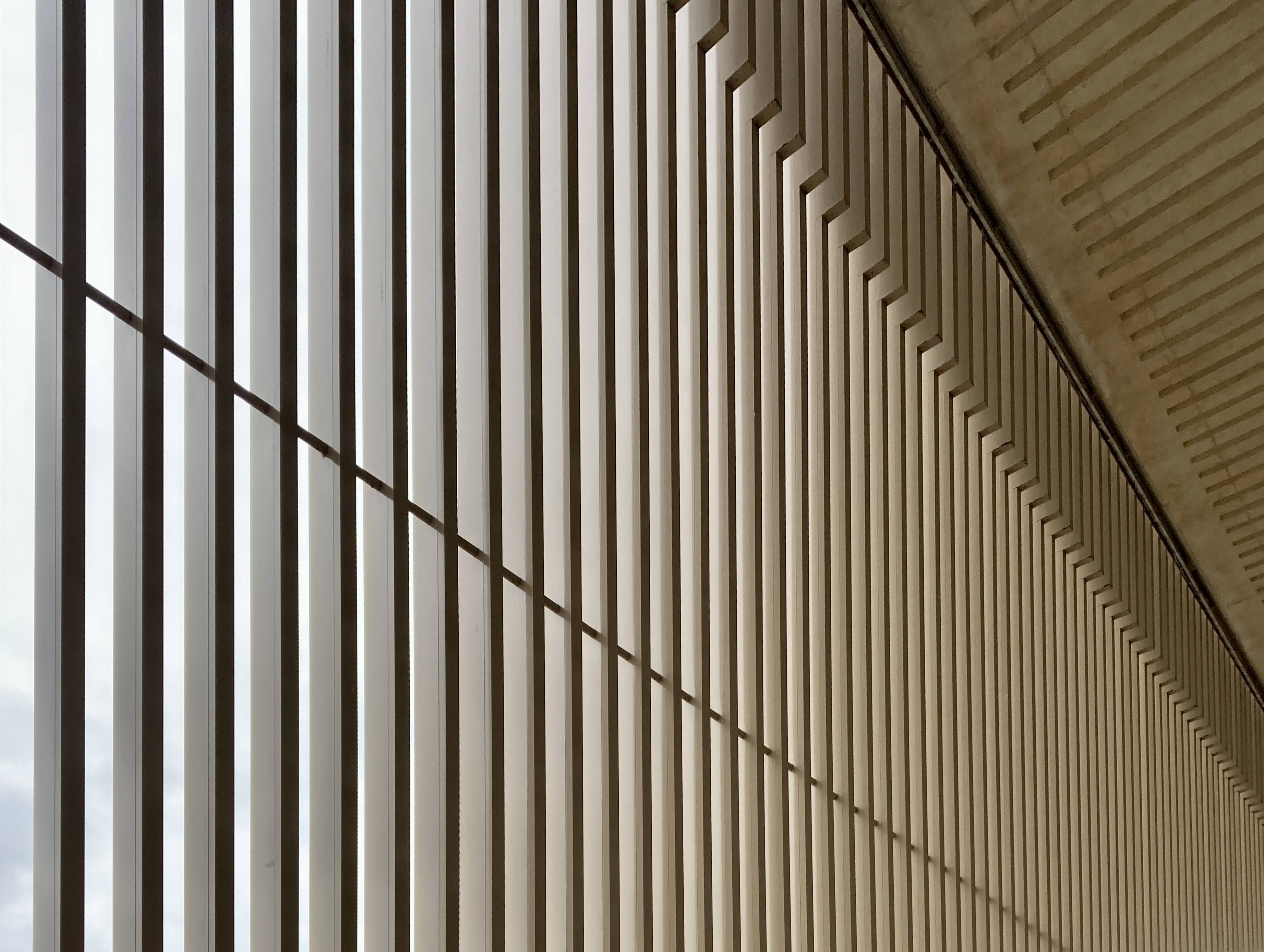
The slatted elements sit behind canopies on each platform which provide shelter to passengers either standing or choosing to sit on London Overground’s standard benches, the wooden slats of which happily complement the station’s design ideas rather well. With eight trains an hour in each direction running at a turn-up-and-go frequency there is no need for anyone to dwell on the platforms for any great length of time. If they are there for a few minutes though, there is a splash of colour to admire in a mural on the Stratford-bound platform 2.

So far, the station has remained fairly clear of clutter and accretions, though the flappy-bag bins which mar many a station look as untidy here as they do anywhere else, and the yellow cones which seem to be ubiquitous across the railway network can be found abandoned in corners. Also, it would be nice if somebody would go round the railway network removing those now-tatty blue “stay apart” stickers which got plastered on station floors and walls during the pandemic but which now just look a mess.
While most stations which get a complete rebuild are old, their structures having reached the end of their lives, it is perhaps surprising to find that Hackney Wick was a relatively new station when rebuilt, having been opened by British Rail in 1980, before ending up transferred to the management of Transport for London as part of London Overground’s Stratford – Richmond/Clapham Junction line. It might not, therefore, have been high up on anyone’s list for rebuilding, except for its location very close to Queen Elizabeth Olympic Park, the main site of 2012’s Olympic Games.
Funding from the Olympic park’s development body London Legacy Development Corporation was made available to improve Hackney Wick station and its links to the surrounding area. Additional funding came from Network Rail, the Greater London Authority, section 106 developer contributions and two London boroughs – the station is on the border of Hackney and Tower Hamlets.
This funding package presented the opportunity not just to enlarge the station to address the number of visitors to the Olympic park post Games, but also to tackle severance issues caused by the railway line, which runs on an embankment.
The ‘old’ Hackney Wick station had entrances off narrow footways on Hepscott Road to the west of the station, with access up to the platforms via long ramps, and a stepped footbridge between platforms. Getting from one side of the railway to the other on foot in the local area also meant going via Hepscott Road and sharing the same narrow footway with railway passengers.

The rebuild of the station and the inclusion of the new subway under the tracks has made north-south pedestrian or bicycle trips in the area much easier, and was/is intended to support the local economy as new businesses and housing move in.
The subway, however, has been the cause of a little local difficulty. In the public part of the subway the outer wall (the one opposite the glass wall) was swiftly covered by spontaneous street art, or ad-hoc graffiti, depending on the viewer’s perception. In March this year Hackney Council, Network Rail and the London Legacy Development Corporation launched a competition to design a new mural for the wall instead. The prize for the winner was to paint their design on the wall, with Network Rail also offering to fund the cost of materials.
This did not go down very well.
Some locals like the street art just as it is, while others picked up on a long-standing gripe from artists that they are often asked to create public art pieces for free, despite the fact that they have bills to pay just like the rest of us. (One of my day job tasks last year was drafting a guide on commissioning community rail artworks, and we very deliberately made sure to include an explanation that commissioners should expect to pay artists for their work).
In May 2023, Network Rail said that, “Following feedback outlining some concerns from the local community regarding the approach set out in the mural project competition, we have taken the decision to end this competition at this time and carry out a review of the project as a whole to address these concerns and ensure we get the right outcome for everyone.” We await with interest.
Mural mores aside, Hackney Wick station has been a brilliant success and recognised as such by winning many awards since it reopened. Its qualities have been acknowledged by RIBA London and RIBA National, the Civic Trust, World Architecture News but obviously the best award it has received was from the Concrete Society, which named Hackney Wick station its outright winner in the UK Concrete Awards 2019.
Beyond Hackney Wick, Landolt+Brown and Hardie have formed a very productive partnership. They also worked together on White Hart Lane, another station rebuild on London Overground, though perhaps a slightly less successful one, somewhat compromised by being completed by a different architect. More happily, they have partnered on plans to remodel and extend the rear of Peckham Rye station, and the station square in front of it, in a project which should excitingly complement the ongoing restoration of the historic station building by Benedict O’Looney Architects.
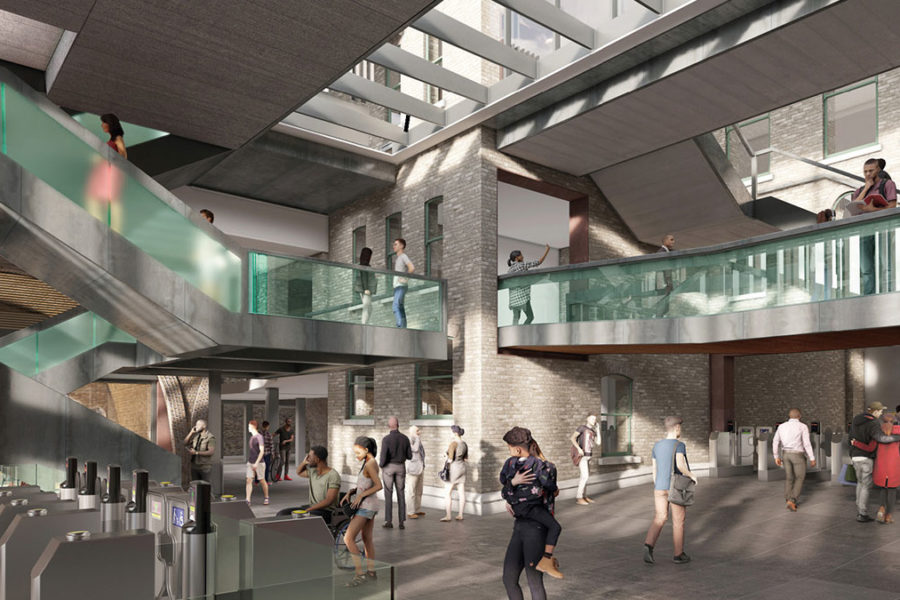
However, the Landolt+Brown/Hardie collaboration with the biggest impact on rail passengers is perhaps more surprising. Not the most high profile of their work, their refurbishment of the toilets at London Victoria station nevertheless enhances the journeys of millions of travellers every year.

These are now some of the best modern toilets on the railway network (regular readers of this website will know of its interest in railway toilet design; an interest which has come as much of a surprise to this website as it probably has to them). A far cry from the dingy loos which could be found at major stations of yesteryear, Victoria’s toilets have been reimagined as luxurious palaces of convenience, inspired by London hotels and the glorious Victorian-era Harbour Board toilets (listed at Category A) at Rothesay Pier ferry terminal on the Isle of Bute.

Illuminated by glass lightboxes overhead, enlivened by greenhouse courtyards with real plants, enhanced by copper and bronze effect doors on the cubicles, and finished with gleaming white tiles, London Victoria’s toilets reopened in 2019 but have left a significant legacy to Britain’s railway. Landolt+Brown were commissioned to draw up Network Rail’s Public Toilets in Managed Stations design manual based on the work at London Victoria, and the standards outlined in the document have been applied to various station toilets across Network Rail’s estate as they have been refurbished. Landolt+Brown followed up its work at Victoria by developing upgrades to the toilets at London Bridge and Charing Cross.
Although they might not spend a lot of time thinking about the artist and architects responsible for their surroundings while they’re spending a penny, millions of passengers nevertheless have reason to be grateful to the partnership of Wendy Hardie and Landolt+Brown. ⯀
- I sometimes give talks on transport architecture to general audiences. Nobody has ever seen Hackney Wick station before and they are always surprised and impressed by it. ↩︎
- Yes, including me. ↩︎
How to find Hackney Wick station
Click here for The Beauty of Transport‘s map
Follow on Twitter/X
To be alerted to new articles, and for more transport architecture, design, branding and cultural references in between, do consider following The Beauty of Transport on Twitter/X: @BeautyOfTranspt. You’ll find me on Twitter/X at @danielhwright for thoughts about wider transport policy and non-transport things too.
FURTHER READING AND BIBLIOGRAPHY
Landolt+Brown’s project page for Hackney Wick station
Wendy Hardie’s project page for Hackney Wick station
Landolt+Brown’s project page for London Victoria toilets
Wendy Hardie’s project page for London Victoria toilets
Network Rail’s current suite of design manuals (including the public toilets manual)
Historic Environment Scotland’s listing citation for the toilets at Rothesay
…and anything else linked to in the text above
 The Beauty of Transport


Re: toilet chat and these esteemed architects. I’m excited about the Peckham Rye development as it’s my local station; I hope you have a chance to visit the elegant loos in the Coal Rooms bar, which were originally part of the station facilities. There’s a niche YouTube video on them, I’ve just discovered. However at London Bridge the otherwise good lavs are let down by the atrociously pixelated images applied to the walls.
Thanks for the chance to relieve myself of these thoughts.
Edited to add, I now see you have already mentioned Peckham Rye’s toilets. You were, of course, ahead of me. And you now have the answer to the pub quiz question ‘which are the only station toilets to be a location in a Disney-backed feature film?’ (Rye Lane)
Edited to add, I now see you have already mentioned Peckham Rye’s toilets. You were, of course, ahead of me. And you now have the answer to the pub quiz question ‘which are the only station toilets to be a location in a Disney-backed feature film?’ (Rye Lane)
I like this station, especially the contrast between the concrete and the splashes of Overground orange. I wonder how it would look if this line were taken over by another operator and the banisters, for example, ended up a different colour.
Not sure if you’ve seen the sad news about Jan Landolt, but RIP:
https://www.architectsjournal.co.uk/news/station-specialist-jan-landolt-dies-at-58